Why I Don’t Identify As New Age To Jesus
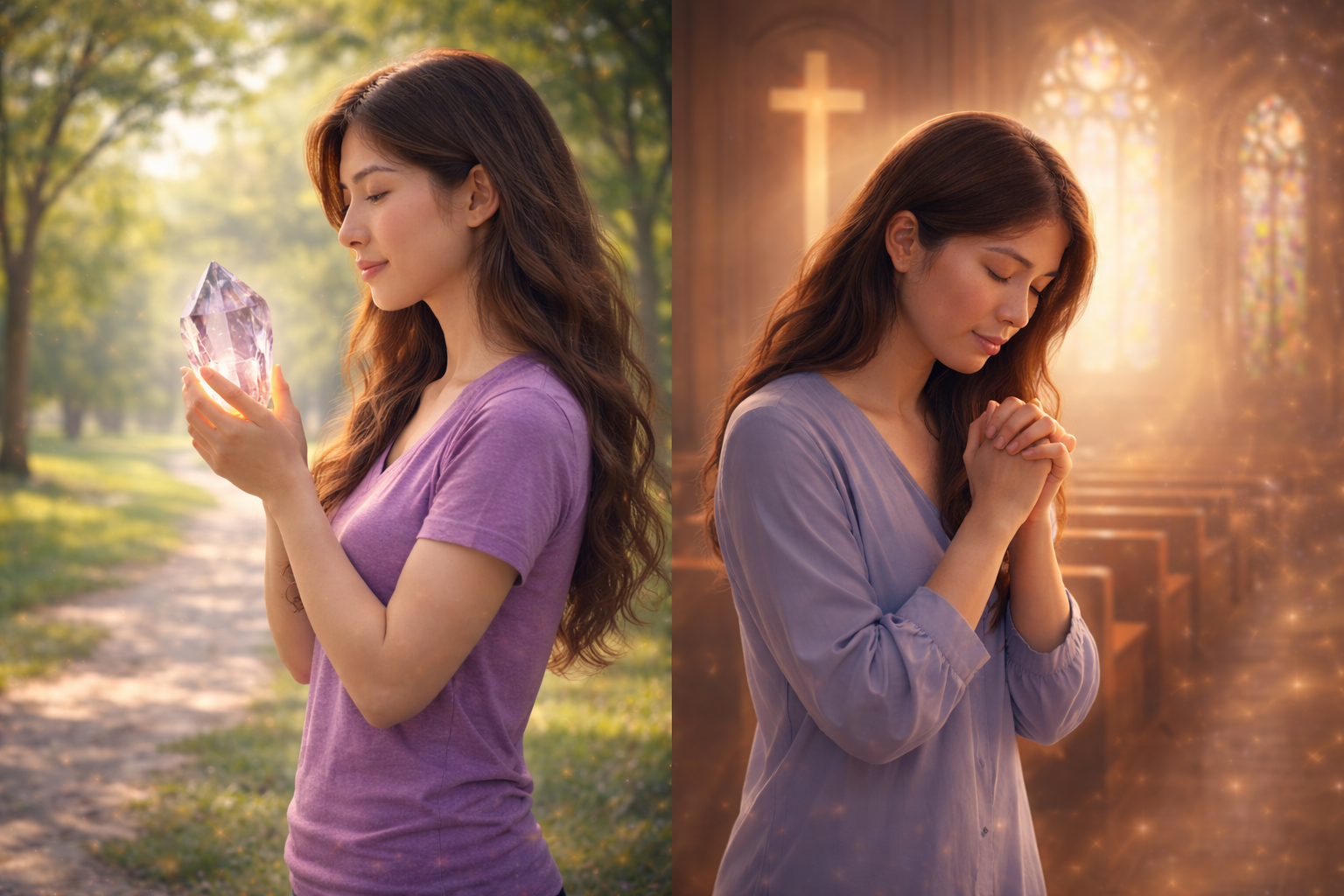
Around 2020, especially during COVID, a wave of people began identifying as “New Age to Jesus.” Conspiracy theories, end-times prophecies, and spiritual awakenings spread rapidly online. Alongside this, something deeper seemed to be happening. Many people, including those in spiritual communities, were experiencing what I would describe as a genuine encounter with God, not just as abstract energy, but as the Holy Spirit.
For a moment, it felt like a bridge was forming between spirituality and Christianity, two worlds that had long been seen as opposites.
But another pattern quickly emerged.
Many who had explored alternative spirituality began rejecting it entirely. After negative experiences with the paranormal, a sense of emptiness, or hedonism in general, they converted to a more rigid form of Christianity and labeled all non-Christian spirituality as demonic. Their stories often followed the same arc: involvement, disillusionment, total renunciation, and a campaign to convert others from the New Age to the “true path” they had found.
The problem is not that some spiritual spaces can be misleading. That is true. The problem is the sweeping conclusion that all spirituality outside of Christianity is inherently evil.
“New Age” became a catch-all term, used inaccurately to describe anything non-Christian. In this framework, all alternative spirituality was reduced to something false, dangerous, and sinful. This led to spiritual people being stereotyped as deceived, witches (the Christian kind), and “serving the Devil,” stereotypes that still persist today.
I never resonated with this movement, largely because the premise itself felt flawed. What was being rejected was not a clearly defined system, but an entire spectrum of beliefs and practices, many of which are nuanced, diverse, and not inherently harmful.
I also noticed that they seemed to advocate a very shallow form of Christianity: either Evangelicalism or Pentecostalism, both of which are cult-like in nature.
I understand why some people arrive at these conclusions. Some have never explored spirituality outside Christianity. Others had negative or confusing experiences and understandably reacted by closing the door completely. I even went through a phase myself where I feared that anything outside Christianity could be demonic. I consumed deliverance content, questioned everything, and felt torn between curiosity and fear.
But over time, that fear stopped making sense to me.
It became clear that a sincere search for truth would not be condemned by a reasonable God. I also recognized that there are real insights within spiritual traditions beyond Christianity. These are often dismissed as “occult,” but in many cases they are simply attempts to understand aspects of reality that organized religion does not address.
Of course, not everything in alternative spirituality is beneficial. There are practices and communities that can be harmful or deceptive. But that does not justify rejecting the entire domain. Spirituality, like any human endeavor, contains both truth and error.
Part of the issue is idealism. Many people enter spirituality assuming that “spiritual” automatically means safe, pure, or kind, especially if they are coming out of rigid or shame-based religious environments. But spirituality is not immune to the same human flaws found anywhere else.
Practices like meditation, astrology, or energy work are not inherently good or bad. What matters is how they are approached and used. The same thing can be constructive or harmful depending on intention, awareness, and context.
When I say that truth can exist outside Christianity, many Christians react defensively. But this overlooks something important. Just as Christianity contains both truth and distortion, so do other spiritual traditions. Reality is broader than any single framework.
Critiquing specific aspects of the New Age movement is reasonable. But reducing all non-Christian spirituality into one category and condemning it outright is an oversimplification.
At its core, this response is often driven by fear. Not always consciously, but underneath it is the belief that even considering other perspectives is spiritually dangerous.
I no longer see it that way.
There are people who move beyond this binary thinking. They are not “New Age Christians,” as they are often labeled, but “Christians of the New Age.”