Are Most Trauma Survivors Meant To Be Healers?

Are most trauma survivors meant to be healers? “Healing” in this case meaning being able to uplift others in any way.
Oof, this is a big question.
In an ideal world, most trauma survivors would embark on a healing journey and give gems they learn back to the collective. That way, the suffering could seem to have meaning.
The dark truth is that MANY trauma survivors don’t start any real healing journey to begin with. Additionally, their energies are so focused on surviving that they are concerned with their immediate needs, not necessarily because they are selfish but because they are barely trying to stay afloat.
I also hesitate to say that trauma survivors are meant to be healers because I don’t want to imply that those who stay stuck in their trauma have somehow failed.
What I do believe is this: Although not all trauma survivors are meant to be healers, I do think some people are equipped to be healers due to the self-healing work they have done on themselves.
Why might this be important to know?
Well, if you have a growth orientation, then you are always learning and expanding. You are the kind of person that engages in regular self-examination, strives to learn from all your life experiences, and constantly apply yourself.
You repurpose every pain, disappointment, and struggle to be useful in some way and don’t let them go to waste. Not because you are neurotic or dramatic—it is simply an innate art.

An old piano repurposed into a planter and fountain
Image credit: Original source
Make no mistake: This is a GIFT and it’s one healer types often take for granted in themselves, ironically, because they are so immersed in their healing.
However, when a healer type can take a step back from their immediate suffering, they can recognize that this, too, is something they are learning from which they can help others with!
Okay, so what if a person never heals a particular issue? Does that mean their suffering is meaningless?
No, it doesn’t mean that their suffering is meaningless. And, to be clear, I am not saying that suffering is always so we can help others, with us being the sacrificial lamb. That is somewhat of a masochistic view.
However, healer types naturally love to share what they learn to help others, whether this is in an explicit or implicit manner. This is one of their joys. So believing there is some greater meaning to their suffering can be a great motivating factor in the midst of challenges.
And, truly, most healers are only able to heal in the way they do because they have gone through their own fair share of difficult experiences.
Some people think that healers were somehow born healed or because they are simply more evolved, but this is not the case. It may only seem that way because of the healing work, so don’t assume someone has always been confident and secure just because they are a mental health professional, coach, or teacher.
And I will say the more profound the healer, the deeper their internal process has probably been. Your mainstream healer who is only drawn to the academic or “socially proofed” form of psychology is usually not that deep, so it’s not that they are automatically more healed. It’s that their own healing journey is on the shallow side, whereas oftentimes, more profound souls can sometimes look “less” healed because their healing journey goes so deep and, therefore, may not be as neat and readily cohesive.
Also, you don’t know these people’s behind-the-scenes. The most “put together” and accomplished people go through their own struggles, too, not necessarily because they pretending to have a perfect life but because we are all human.
So if you have a tendency to put yourself down when you are struggling, give yourself credit for learning through the process, because one day you might be able to help others with the very pains you are going through.
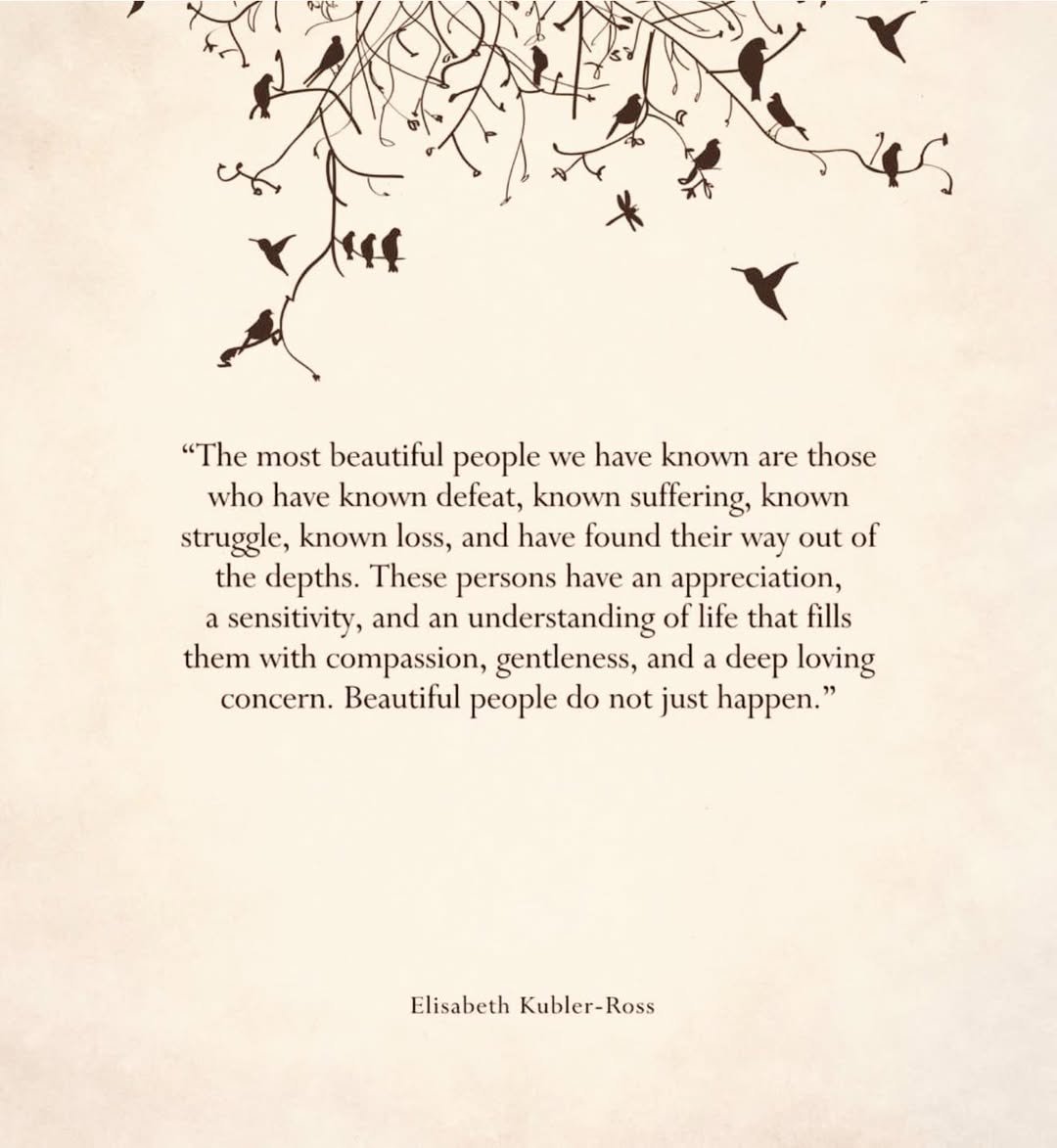
- Elizabeth Kubler-Ross